Swansea first centre in Wales to join UK-wide skin cancer radiotherapy trial
A Swansea hospital is the first in Wales to join a UK-wide clinical trial focusing on the treatment of a common type of skin cancer.
Experts at the South West Wales Cancer Institute at Singleton Hospital have already recruited the first three patients from Wales to take part in trial, called SCC-AFTER.
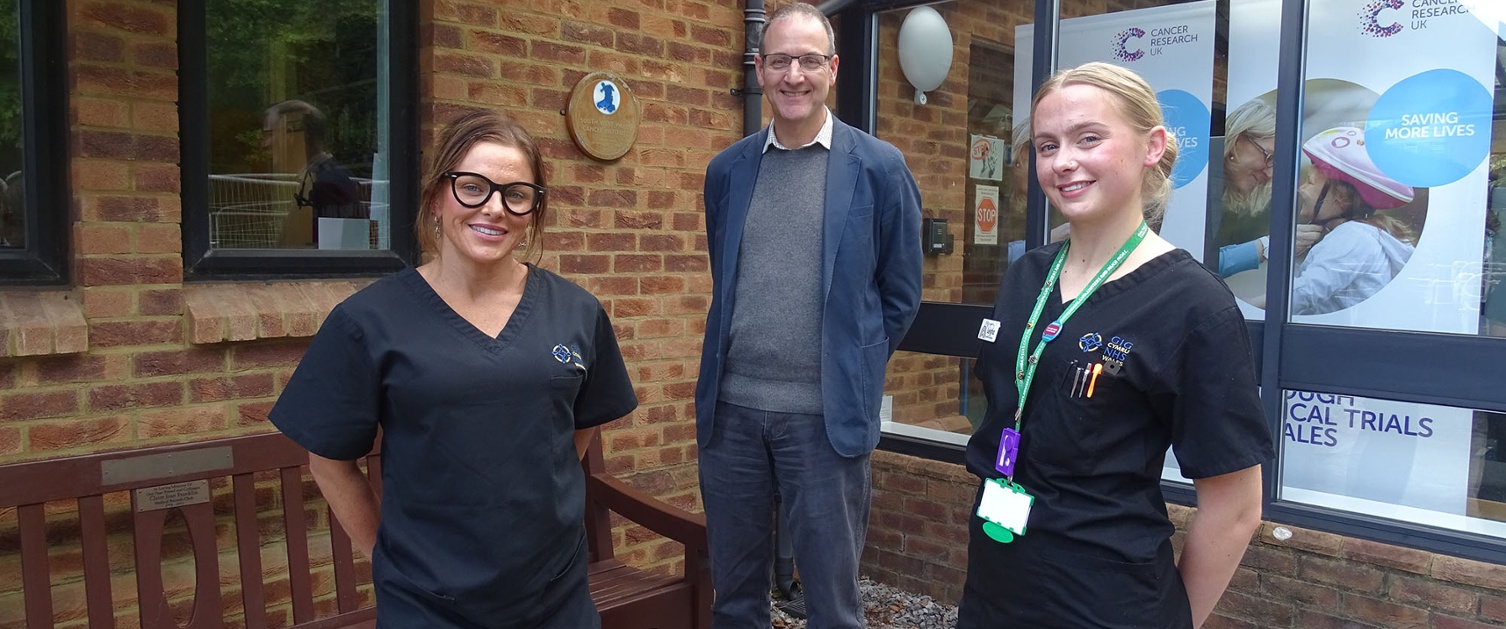
Pictured above: Senior research radiographers Victoria Morris (left) and Leigha Yardley with consultant clinical oncologist Martin Rolles
Skin SCC, Squamous Cell Cancer, is the UK’s second most common form of non-melanoma skin cancer. There are upwards of 50,000 new cases diagnosed every year and the number is growing.
Radiotherapy is routinely given to people with high-risk skin cancer after curative surgery to try to reduce the chances of the cancer coming back. This is known as adjuvant radiotherapy.
The alternative is close clinical monitoring to check if there are signs the cancer is returning, and to treat with radiotherapy only if it does.
The trial aims to find out which patients can safely avoid radiotherapy, sparing them side-effects and disruption when they will not necessarily benefit from it.
At the same time it will free up radiotherapy capacity for other patients, something that is already happening in the Swansea centre.
Dr Martin Rolles, consultant clinical oncologist at Singleton, said: “SCC is a very common form of skin cancer. We see hundreds of cases a year. It often occurs in quite elderly people and when caught early it is highly curable.
“This trial is looking at whether we always need to give adjuvant radiotherapy after curative surgery.
“We give lots of adjuvant radiotherapy for SCC, but no one is really sure when we can avoid giving it. We are probably overtreating.
“When there is no evidence, we tend to err on the side of caution and give radiotherapy. We can probably avoid that in a proportion of patients.”
The trial is randomised controlled. Half the patients recruited are randomised not to have radiotherapy and the other half will get it.
Dr Rolles said: “We will then look to see if there is a difference in outcomes. We try to offer the trial to all suitable patients, and they are generally enthusiastic.
“Radiotherapy requires a number of visits to Singleton Hospital, which can be difficult for patients who are often elderly and immobile, especially as our patients come from all over South West Wales.”
Singleton has recruited three patients so far, one of the highest number in the UK. Two of the patients have been randomised to receive close clinical monitoring and the other to also receive radiotherapy.
 The number of recruits is expected to increase significantly as the trial ramps up. Senior research radiographer Leigha Yardley said: “We have had other skin cancer trials here in the past, but they were all drug trials while this is a radiotherapy trial.
“This is the first non-melanoma skin cancer study for a long time. The more familiar we get with it, the quicker we can identify eligible patients.
“It’s a learning curve for us. The longer the trial goes on, the easier it will be to recruit.”
As clinical trials require gold standard care, the team has already streamlined pathways. That means pathology and histology reports for all cancer patients are now available quicker than they previously were.
Senior research radiographer Victoria Morris said this was in line with the Welsh Government’s planned care recovery plan, which sought to reduce waiting times and unnecessary hospital visits.
“And then you get to develop treatments for those other cancers as well, because you’re allowing staff to train and specialise in different treatments,” she added. “Radiotherapy trials benefit the whole cancer service.”
Note:
SCC-After is sponsored by Cardiff University and coordinated by its Centre for Trials Research, which is funded by Health and Care Research Wales.
Funding to run the trial and for NHS Research costs is provided by the National Institute for Health and Care Research.
It aims to recruit 840 patients across the UK over the next four years. The study will monitor all patients for cancer recurrence, treatment side effects and quality of life.
Rydym yn croesawu gohebiaeth a galwadau ffôn yn y Gymraeg neu'r Saesneg. Atebir gohebiaeth Gymraeg yn y Gymraeg, ac ni fydd hyn yn arwain at oedi. Mae’r dudalen hon ar gael yn Gymraeg drwy bwyso’r botwm ar y dde ar frig y dudalen.
We welcome correspondence and telephone calls in Welsh or English. Welsh language correspondence will be replied to in Welsh, and this will not lead to a delay. This page is available in Welsh by clicking ‘Cymraeg’ at the top right of this page.