Changing inhalers could prove breath of fresh air for patients and planet
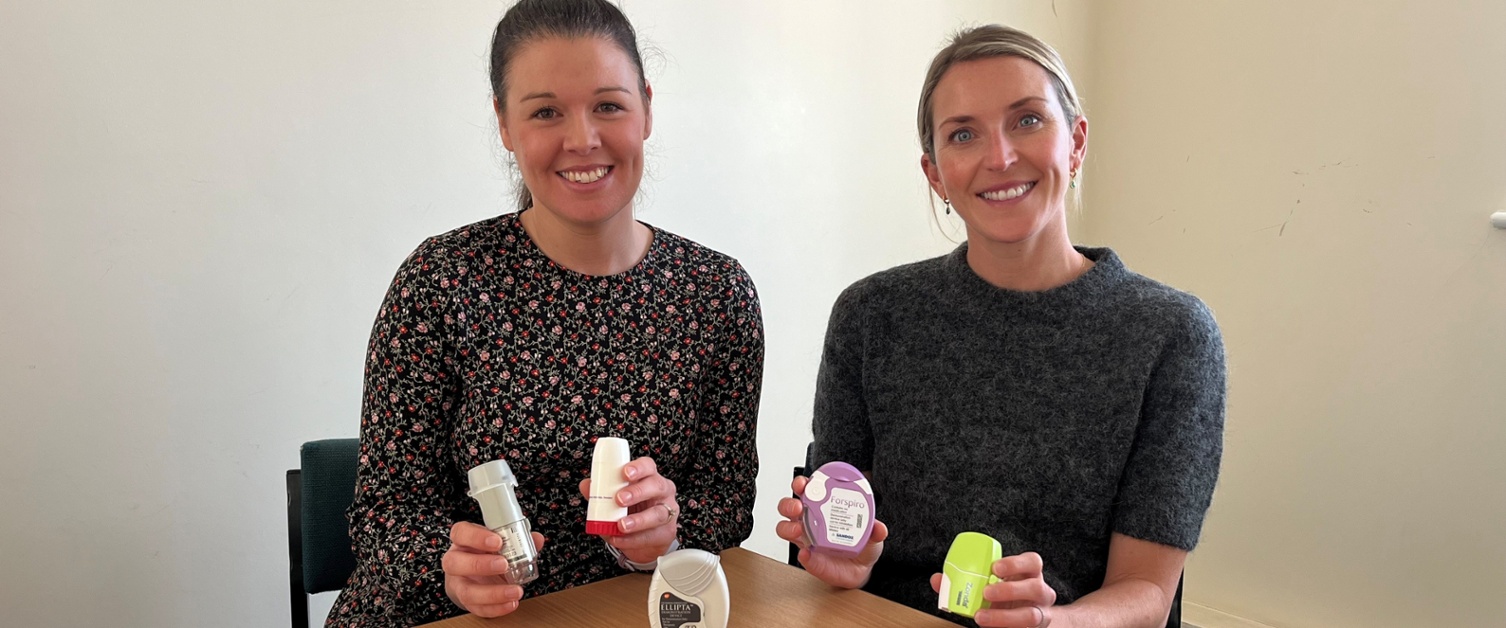
PICTURED: Kirsty Speakman, Clinical Lead Pharmacist, Primary Care and Carys Howell, Primary Care Pharmacist, with the inhalers.
Informing patients about how to get the best use of inhalers could prove a breath of fresh air for themselves and the environment.
Many patients discover they can switch their metered dose inhalers (MDIs) to dry powder inhalers (DPIs), which benefits their lung condition and is kinder to the planet.
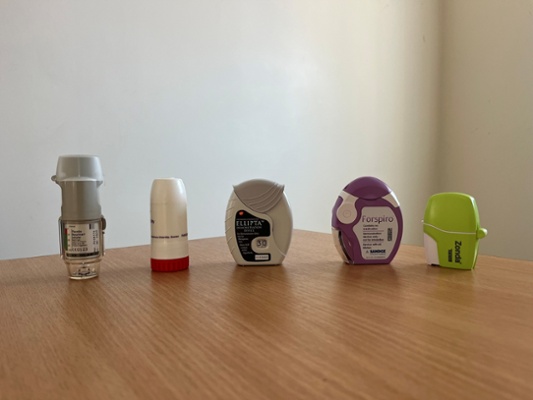 Whether this is an option for them can be checked during their regular respiratory reviews. Their GP, pharmacist or nurse will assess their inhaler use and technique to ensure it is being used correctly. They will also discuss the patient’s condition and overall management to determine whether the right inhaler is being used or if there was a better alternative.
Patients can find information around inhalers via a newly-created section on the health board’s website.
Kirsty Speakman, Clinical Lead Pharmacist, Primary Care said: “Even though it can be daunting to change inhalers, a lot of patients not only find these alternatives easier and simpler to use but their lung condition is also better controlled as a result.
“Dry powder inhalers can be a great option for some people, but they’re not suitable for everyone. That’s why it’s important to have a proper assessment to find what works best for you. These inhalers work best when you’re able to breathe in quickly and deeply, so they may not be the ideal choice for younger children or older adults who struggle to take a deep breath.”
Switching inhalers can also have a significant impact on our environment.
MDIs often contain a propellant called hydrofluoroalkane (HFA), which is a potent greenhouse gas. They deliver a specific amount of medication in aerosol form, rather than as a pill or capsule. Even when these inhalers are sent to landfill, the HFAs can slowly leak out of the inhalers and contribute to global warming.
In contrast, DPIs and soft mist inhalers (SMIs) do not contain HFA propellants and generally have a significantly lower carbon footprint than MDIs.
In terms of emissions, the use over a year of a typical single MDI equates to driving from Swansea to Liverpool in a petrol car. But using a typical DPI is the equivalent of driving just four miles – about the distance from Singleton Hospital to the Swansea.com Stadium.
Carys Howell, Primary Care Pharmacist, said: “Certain inhalers can release powerful greenhouse gases that contribute to climate change and increase air pollution which can worsen lung conditions.
“Using greener inhalers will reduce the impact inhalers have on the environment, benefitting the world we live in and improving the air we breathe.”
 Even if a more environmentally friendly inhaler isn’t right for you there are still things you can do to help the environment.
Rhian Owen, Primary Care Pharmacist, said: “The most important thing is having an inhaler that is right for the patient and their lung condition. Even if it’s not appropriate for some patients to switch to a greener inhaler, there are still actions that can be taken to reduce the impact of their inhalers on the environment. For example, only ordering inhalers when needed to reduce waste and disposing of inhalers in a safe and environmentally friendly way.”
PICTURED: Dr Kannan Muthuvairavan.
The health board has recently launched a dedicated Going Green with your Inhalers section on its website.
The website offers information around inhaler usage, and how patients can get the most out of their inhaler to aid their condition and the environment.
Dr Kannan Muthuvairavan, the health board’s primary care lead for respiratory diseases and a GP at Estuary Group Practice, said: “As a Respiratory Lead GP, I’m pleased to support the Going Green with your Inhalers campaign.
“This website is a great resource to help patients understand how their inhalers can affect the environment and what simple steps they can take to make a difference.
“By learning more about the types of inhalers available and how to use and dispose of them responsibly, patients can look after both their health and the planet.
“I’d encourage anyone who uses an inhaler to take a few minutes to explore the site and talk to their healthcare team about the options that work best for them.”
Rydym yn croesawu gohebiaeth a galwadau ffôn yn y Gymraeg neu'r Saesneg. Atebir gohebiaeth Gymraeg yn y Gymraeg, ac ni fydd hyn yn arwain at oedi. Mae’r dudalen hon ar gael yn Gymraeg drwy bwyso’r botwm ar y dde ar frig y dudalen.
We welcome correspondence and telephone calls in Welsh or English. Welsh language correspondence will be replied to in Welsh, and this will not lead to a delay. This page is available in Welsh by clicking ‘Cymraeg’ at the top right of this page.