From wheelchair to walking again and eloping to the Little White Chapel
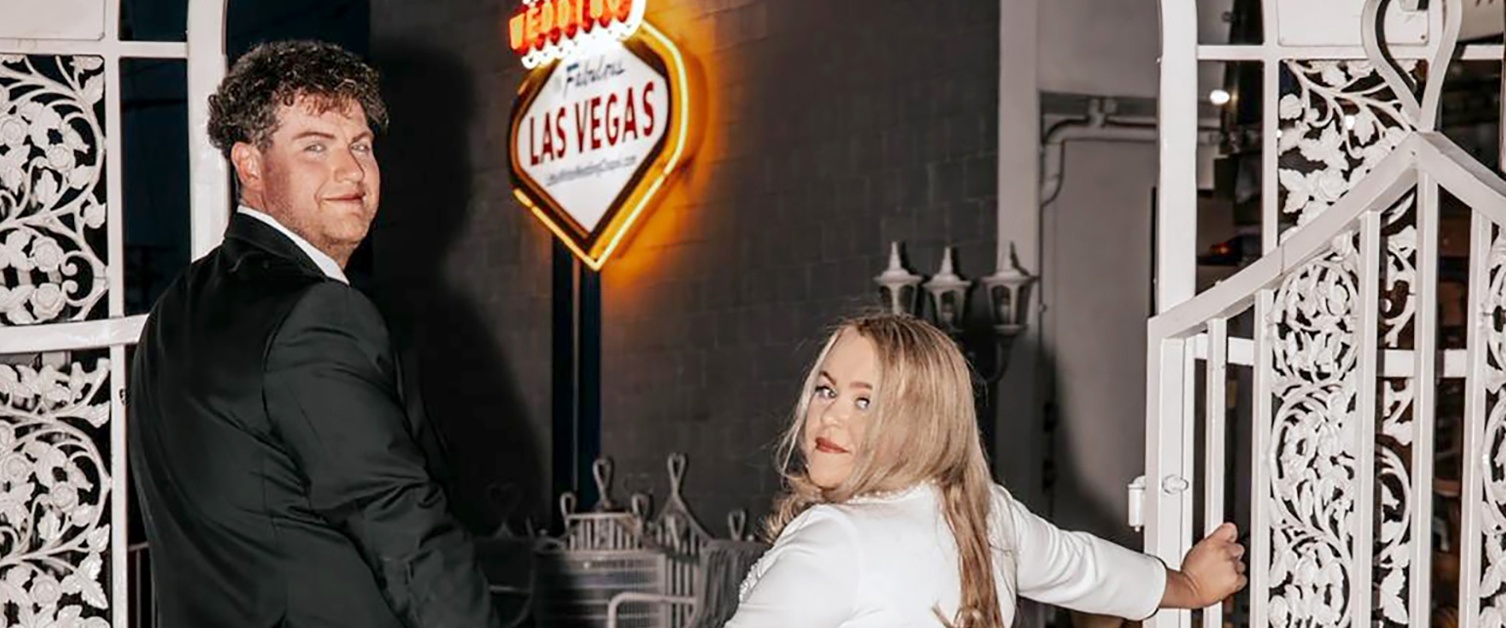
A woman suddenly paralysed by a rare condition has learned to walk again and eloped to Las Vegas to get married after fearing she would need a wheelchair for life.
Jemma Griffiths, 29, from Swansea is also expecting a baby and said she owes her progress to physiotherapist David Morgan who has been a “driving force”.
She returned to Neath Port Talbot Hospital, the place where David helped her take her first unaided steps, to see him presented with a Patient Choice Award following her nomination.
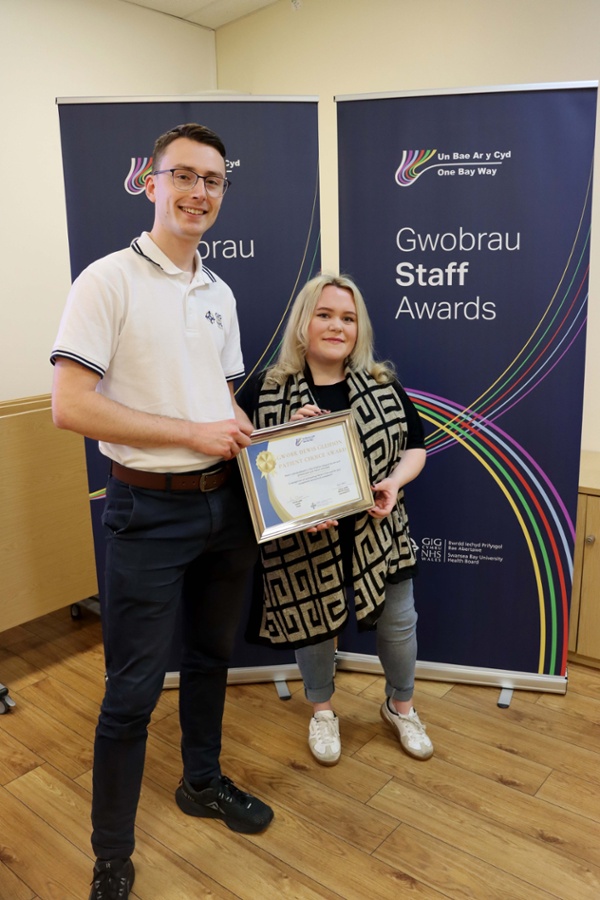 Physiotherapist David Morgan and Jemma Griffiths at the Patient Choice Awards
Credit: SBUHB
Physiotherapist David Morgan and Jemma Griffiths at the Patient Choice Awards
Credit: SBUHB
David said: “It’s an honour to have a nomination, but it was a partnership the whole way through.”
In early 2024 Jemma, an accommodation officer for a housing charity, was left terrified when sudden significant pain in her back progressed and she lost all feeling from her waist down.
She had been diagnosed with a bulging disc a year earlier, which is when a soft cushion of tissue between the bones in the spine bulges outwards. But this deterioration came out of the blue.
Tests revealed she had cauda equina syndrome, a rare and very serious condition caused by the compression of the nerves at the base of the spinal cord. These nerves control leg movement and bladder and bowel movement and pressure on them causes damage.
Jemma was rushed into Morriston Hospital for surgery to decompress the nerves, but when she woke up from the operation she found she had recovered little movement.
“I could move my pelvis to my knee, but the knee down was totally paralysed,” she said.
When she was referred as an outpatient to David in Neath Port Talbot Hospital a few weeks later she was completely reliant on a wheelchair.
“At one point I thought being in my wheelchair would be my forever,” said Jemma.
“I said ‘David, you have to fix me’.
“In the beginning I couldn’t do a lot because my legs were like jelly. I couldn’t even use my crutches. But David was always so encouraging.”
“We brought it back to basics,” said David, who provided Jemma with two to three sessions of physiotherapy every week at first.
“We did yoga and Pilates-style exercises to try to build some awareness, control and core strength.
“We also used the hydrotherapy pool here in the hospital. We used all the equipment we could get our hands on."
Jemma progressed from her wheelchair to using crutches until she was able to take her first unaided steps with David by her side.
As her confidence grew, so did the distance she could walk until she went the length of a hospital corridor on her own.
Jemma said: “They say with cauda equina that outcomes are in thirds: a third of people will be almost as they were before, a third won’t recover and a third will recover some function.
“I think I’m in the third bracket with some function. They also say you have a two-year window after cauda equina to make progress and I think I have made as much progress as I can.
“I don’t need my mobility aids all the time now, although I do fatigue easier.
“But I’m in a good place now and I wasn’t two years ago. I’m far more confident than I ever thought I would be.
“My partner Liam and I even eloped to Las Vegas, just the two of us, and had a Pink Cadillac marriage ceremony in the Little White Chapel.”
Photos show Jemma in sky-scraper high heels, but she said as skilled as David is, “the one thing he couldn’t do was teach me to walk in heels again! I just had to stand by the car”.
Jemma added: “David is a driving force for how things have progressed.
“He is really passionate about his job and would go away and research my condition in his own time between appointments, so he had more ways he could help me.
“There’s not a single thing he could have improved on.”
Jemma’s mum Joanne Heatley said: “I remember when Jemma was in tears thinking she would never walk again but just look at where she is now. And David is paramount to that.”
- The Patient Choice Awards are an annual feature of Swansea Bay University Health Board’s staff recognition programme and are awarded directly as a result of patient and family nominations. This time more than 500 nominations were received with hundreds of awards handed out across more than a dozen events.
Rydym yn croesawu gohebiaeth a galwadau ffôn yn y Gymraeg neu'r Saesneg. Atebir gohebiaeth Gymraeg yn y Gymraeg, ac ni fydd hyn yn arwain at oedi. Mae’r dudalen hon ar gael yn Gymraeg drwy bwyso’r botwm ar y dde ar frig y dudalen.
We welcome correspondence and telephone calls in Welsh or English. Welsh language correspondence will be replied to in Welsh, and this will not lead to a delay. This page is available in Welsh by clicking ‘Cymraeg’ at the top right of this page.