Paracetamol project shows tablet is not a bitter pill to swallow for patients and planet
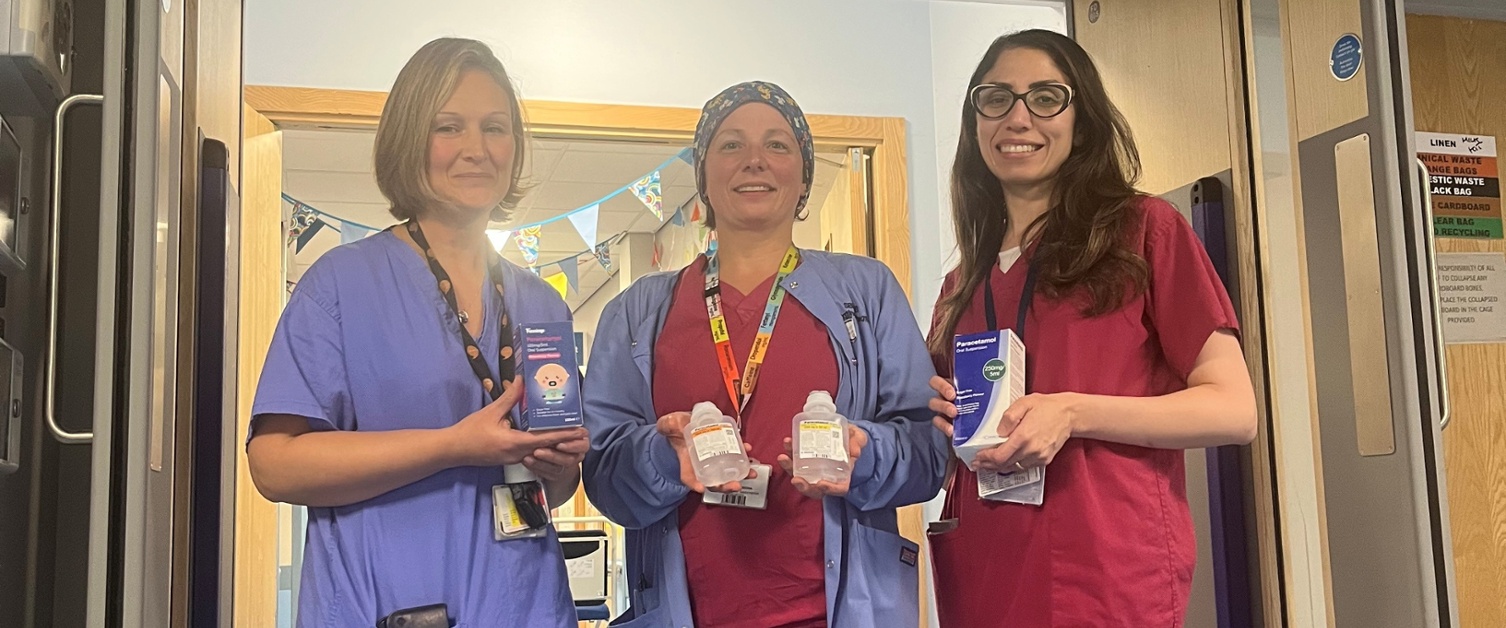
PICTURED: Consultant Anaesthetists Rebeca Harris and Tereza Soskova along with Senior Clinical Fellow Lara Sabry.
Work analysing how paracetamol is given to young patients has paved the way to make better use of NHS resources and deliver positives for the planet, without compromising patient care.
Five Swansea Bay clinicians have led a project focusing on the differences between offering children paracetamol by mouth, or intravenously.
They looked at how children having planned surgery at Morriston Hospital were given the painkiller.
Previously, when paediatric patients were put under general anaesthetic for their surgery, paracetamol was given to them via a canula in a vein in their hand.
 Now, however, the process is changing. Young patients will instead be given oral paracetamol – in liquid or tablet form – before they go under anaesthetic and into theatre.
This follows the project’s findings which demonstrated that oral paracetamol gave the same level of pain relief when the patient woke up from surgery.
But unlike IV, it scored much higher on cost-savings and being kinder to the environment.
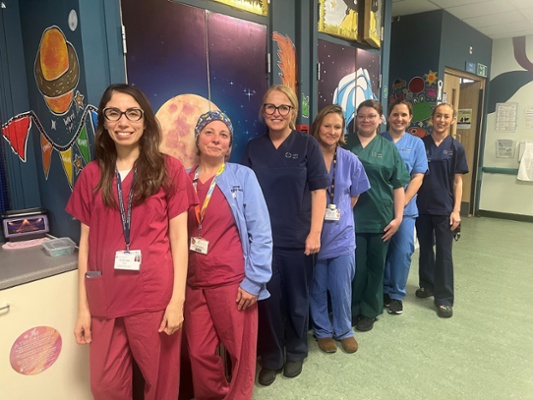
PICTURED: Staff from the Children's Ward have been part of the project.
This is because oral paracetamol costs just pennies, and the environmental impact of manufacturing and administering it is just a fraction of the IV version.
The project identified that avoiding IV paracetamol for paediatric planned surgery would save the equivalent environmental impact of driving over 23,000 miles a year.
The Improving Paracetamol use with Routine Oral over Venous administration (IMPROVE) project has been led by Consultant Anaesthetists Tereza Soskova, Rebeca Harris and Alex Morgan along with Senior Clinical Fellow Lara Sabry and Core Trainee doctor Linn Jarte.
Dr Soskova: said: “In terms of patient impact, there’s no difference in either safety or analgesic efficacy between IV or oral.
“Using oral paracetamol leads to 98.3 per cent cost savings. When this project was initially set up, in-house calculations found that IV paracetamol was 24 times more expensive than oral tablets.
She added: “In terms of carbon emissions, IV paracetamol results in up to 12 times higher emissions than oral tablets.
“That has changed our view on paracetamol usage, and we are looking to switch to a 90 per cent oral usage rate.”
The findings showed throughout 2024, 90 per cent of paracetamol was administered intravenously for over 1,300 paediatric patients.
However, if paracetamol had been given orally instead, it would have saved 9,190kg of eCO2 – the equivalent of driving 23,403 miles in a petrol car.
Using IV was also £1,150 more expensive over that time.
Dr Soskova added: “A paper from the British Journal of Anaesthesia (BJA) published last year looked at the environmental and financial impacts of perioperative paracetamol use.
“They mention that healthcare is responsible for five per cent of greenhouse gas emissions globally – so our profession makes up a significant part of the problem.
“Of this, pharmaceuticals make up 19-32 per cent.
“Paracetamol is one of the most commonly used medications – it makes up six per cent of all pharmaceutical sales worldwide.
“So we wanted to look at the impact we are making in Swansea Bay, and that led to this project.”
Now the project is looking to expand into planned adult surgery in Morriston, Singleton and Neath Port Talbot hospitals, where the greater numbers of patients mean the opportunities to save financial and environmental resources will be scaled up considerably.
Rydym yn croesawu gohebiaeth a galwadau ffôn yn y Gymraeg neu'r Saesneg. Atebir gohebiaeth Gymraeg yn y Gymraeg, ac ni fydd hyn yn arwain at oedi. Mae’r dudalen hon ar gael yn Gymraeg drwy bwyso’r botwm ar y dde ar frig y dudalen.
We welcome correspondence and telephone calls in Welsh or English. Welsh language correspondence will be replied to in Welsh, and this will not lead to a delay. This page is available in Welsh by clicking ‘Cymraeg’ at the top right of this page.