Sustainable roles continue to have care, carbon and cost at its core
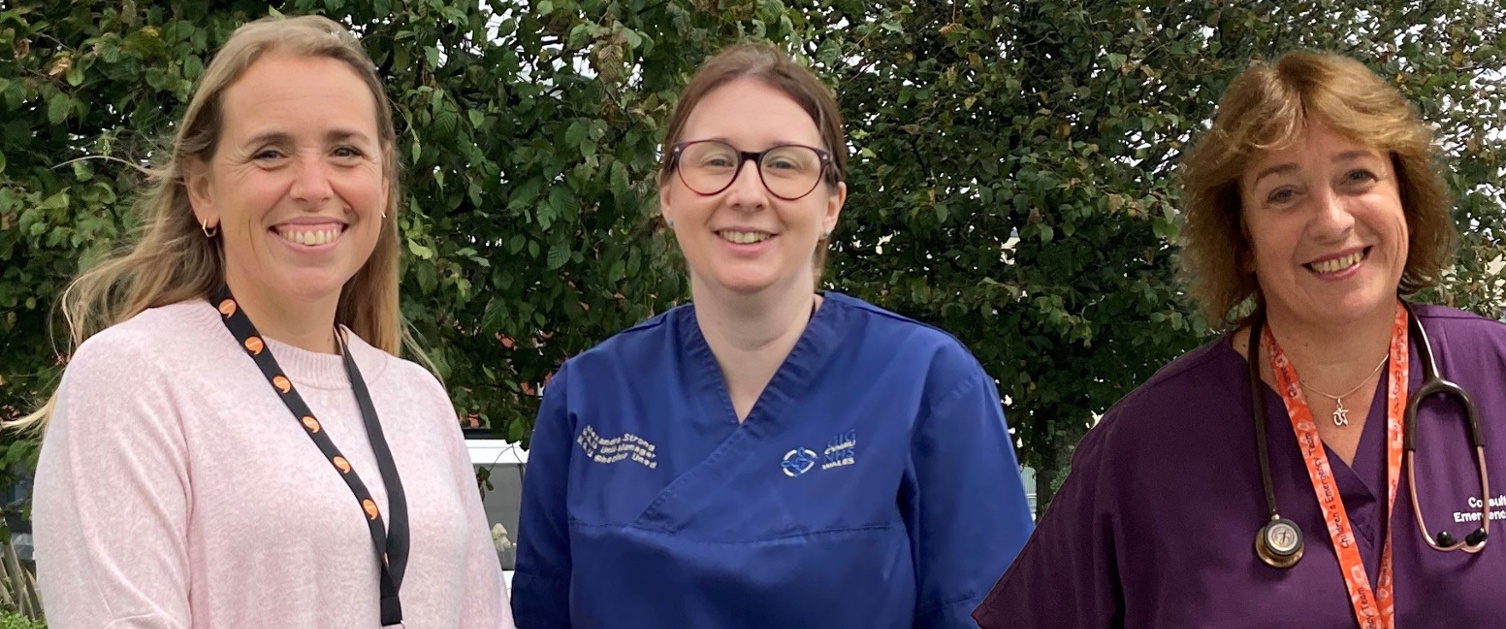
PICTURED: Elana Owen, Alexandra Strong and Sue West-Jones are the health board's sustainable clinical leads.
Three clinicians delivering sustainable change within Swansea Bay are set to continue, as their green efforts are making positive impacts on patient care as well as reducing our carbon footprint and cutting costs.
Following the appointment of three sustainable clinical leads in 2023 – a first for the health board - Sue West-Jones, Elana Owen and Alexandra Strong have been leading on projects that have patients and the planet at its core, along with saving valuable resources.
 They have also encouraged and supported colleagues to make changes within their departments and develop projects which could be spread across the health board.
The latest success has come in a health board-wide switch from single-use to reusable blood pressure cuffs – a change that will save over 118 tonnes of carbon dioxide equivalent (CO2e), which equates to 22 car journeys around the world every year. It will also save over £192,000 by reusing equipment.
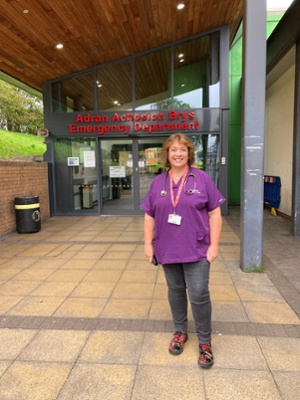
PICTURED: Dr West-Jones works in Morriston Hospital's Emergency Department.
Such has been the success of the new roles, which offers them dedicated time to focus on sustainability, the trio have agreed to continue their extra responsibilities for another year.
Dr West-Jones is a Consultant in Morriston Hospital’s Emergency Department (ED).
Despite working in a fast-paced, challenging environment, she believes ideas implemented in ED shows sustainable changes are possible even in the busiest of departments.
Their efforts have been rewarded by being granted bronze status by GreenED - a framework developed by the Royal College of Emergency Medicine which encourages environmentally sustainable practices within the specialty of emergency medicine.
Dr West-Jones said: “Throughout my first two years as a sustainable clinical lead, huge efforts have been made to look after patients and the planet, which in turn deliver financial savings.
“Attitudes and understanding of the need for change has been helped by educating staff and seeing the success of projects. The engagement of ED staff has been encouraging.
“Education around sustainability is now given to foundation year one and two doctors and all new nurses.
“In ED we work in a very busy environment, but I feel that if we can impose positive change within our department then this gives other services encouragement to either take our projects into their way or working or evaluating their own approaches and identifying any possible changes.
“We’ve achieved a lot already in ED. We’ve reduced the amount of cannulation we use and cut our use of intravenous paracetamol. We’ve also switched to a new form of tournistrip that is better for patient comfort, saves waste and money, along with introducing Tiger bags for non-infectious waste.
“These small changes have all added up to £90,000 annual savings. Scaled across the organisation this action would save considerable sums of money whilst improving patient care.
“Considering what we’ve achieved already, I’m really looking forward to supporting and seeing projects come to fruition in the next 12 months.”
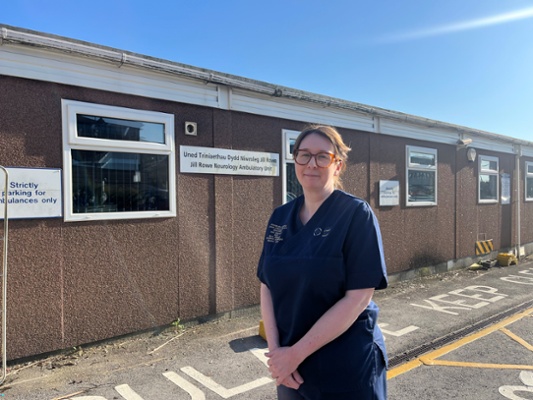 Alexandra Strong is the manager of the Jill Rowe Neurology Ambulatory Unit - a treatment and day procedure unit for people with a range of different neurological disorders.
It carries out investigations such as lumbar punctures, cognitive assessments, plasma exchange as well as treatments including infusions and injections.
PICTURED: Alexandra Strong.
The unit has been part of the trial of Tiger bags being rolled out across the health board.
Tiger bags are used for non-infectious waste such as nappies, wipes, sanitary products and dressings and bandages. They mean waste is now being disposed of in a more environmentally-friendly way as they are instead recycled and used as a fuel in cement kilns, or direct to energy from waste facilities.
The trial, in selected wards across Morriston and Singleton hospitals, has seen the health board’s Tiger bag disposal rising from two tonnes per month up to 14. It could save up to £100,000 a year once rolled out throughout the health board.
Alexandra has also set up a new Green Wards Accreditation scheme, which support services within the health board to become more sustainable.
Alexandra said: “As one of the clinical leads for sustainability in the health board I am interested in how we can build our healthcare to be sustainable for the future and be proactive, rather than reactive.
“The switch to Tiger bags has been an easy change within our department due to the willingness of staff to adopt new regulations and understand the need for change.
“In my sustainable clinical lead role, I have found that staff are really interested but some don’t necessarily have the time to investigate and follow through with ideas. That’s where the sustainable clinical leads come in and help get those projects and ideas moving forward.
“Having another year in the role gives us time to build on the changes made and help other departments do the same.
“We’ve made some good progress with swapping single use equipment for reuseable products. The Green Wards Accreditation scheme is now up and running, plus there is already GreenED, Green Intensive Therapy Unit and Green Primary Care in place, and they have been successful, so that is something I’m looking to develop further.
“I believe that starting with small changes, sustainability and being cost effective while providing the best standard of care is achievable.”
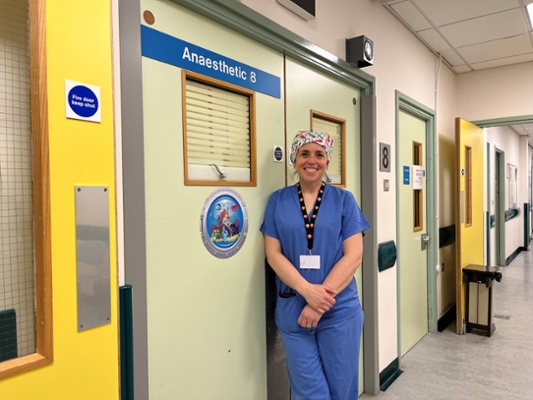 Dr Owen is a Consultant Anaesthetist based in Morriston Hospital’s Theatres.
She has been integral in switching the health board’s supply of nitrous oxide from its manifold system and pipework to cylinders at the point of use.
Nitrous oxide, commonly known as laughing gas, is a medical gas that is used across the health board by services such as theatres, labour ward and ED.
PICTURED: Dr Owen.
It is, however, a potent greenhouse gas – 300 times more so than carbon dioxide.
The change has been implemented in Morriston and Neath Port Talbot Hospitals, with Singleton next in line to make the switch.
The project has been one of the leading successes in her stint as a sustainable clinical lead.
Dr Owen said: “It has been encouraging seeing how the nitrous oxide project has progressed. It’s making a significant reduction on the health board’s carbon footprint.
“We’ve also managed to change the procedure around young patients and painkillers. They are now given oral paracetamol – in liquid or tablet form – before they go under anaesthetic and into theatre.
“A project demonstrated that oral paracetamol gave the same level of pain relief when the patient woke up from surgery but, unlike IV, it scored much higher on cost-savings and being kinder to the environment.
“These are just some examples of the excellent work going on within Swansea Bay.
“We are definitely making progress. There is much more of an appetite for change.
“There’s a lot more cross-departmental learning and collaboration, which is very exciting, encouraging and important.”
Rydym yn croesawu gohebiaeth a galwadau ffôn yn y Gymraeg neu'r Saesneg. Atebir gohebiaeth Gymraeg yn y Gymraeg, ac ni fydd hyn yn arwain at oedi. Mae’r dudalen hon ar gael yn Gymraeg drwy bwyso’r botwm ar y dde ar frig y dudalen.
We welcome correspondence and telephone calls in Welsh or English. Welsh language correspondence will be replied to in Welsh, and this will not lead to a delay. This page is available in Welsh by clicking ‘Cymraeg’ at the top right of this page.