Switching plastic for paper tourniquets proves popular with patients
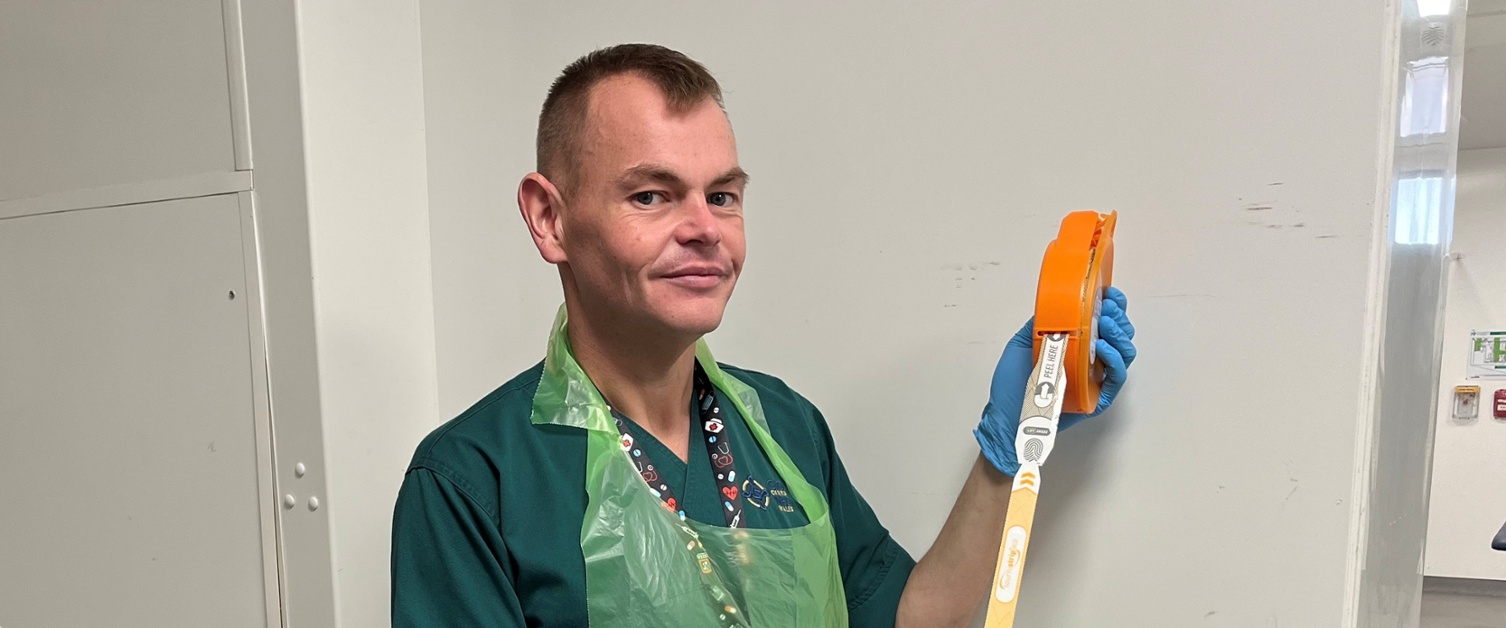
PICTURED: Ian Booth, Emergency Department Assistant, shows the new tourniquets being used in Morriston Hospital's ED.
A successful trial of paper tourniquets in Morriston Hospital has proven to be kinder to both patients and the planet.
Tourniquets are used for routine medical procedures such as drawing blood and placing cannulas.
The Emergency Department (ED) has run a five-month trial analysing the effect new laminated paper tourniquets have had on its patients, waste and health board finances.
Compared to the previous single-use plastic version supplied from China, the paper device doesn’t have any sharp edges and can also be reused up to five times per patient.
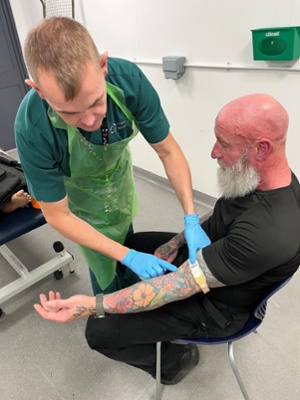 The new paper version, Tournistrips, is also made in the UK, cutting global traffic and reducing the health board’s supply chain environmental emissions.
Tournistrips also come in child-friendly designs which help distract nervous youngsters.
They are now being rolled out further, with the Acute Medical Unit (AMU) and Same Day Emergency Care (SDEC) also using the paper tourniquets.
PICTURED: The new tourniquets have proved popular with patients.
Emergency Consultant and one of the health board’s three Sustainable Clinical Leads, Sue West-Jones, said: “They are quick and easy to apply, can be released and repositioned easily and can be reused up to five times on the same patient, which is useful for repeated medical tests. Additionally, they have not caused indentation on the patient’s arm.
“They had already been successfully trialled and formally adopted by the vascular access specialist nurse team in Morriston, who particularly liked the fact they couldn’t be over-tightened on the limb. Evidence suggests that over-tightening can lead to failure to take blood, distortion of laboratory results and pain for the patient.
“The trial in ED has been a big success as it has reduced the chance of harm to patients, been beneficial to our environment – we are still looking into the savings in emissions - and it will save the health board money.
“We are using two types of tourniquets - eco and paediatric. The latter have designs including highly colourful snakes and elephant trunks and have assisted in the venepuncture of children and patients with dementia and those with additional learning needs.
“Several children have asked to keep the tourniquets as keep-sakes. The colourful strips act as distraction and play, and the feedback from the Children’s Emergency Unit’s staff has been very positive.
“Now we look forward to seeing the results emerge from the trials in AMU and SDEC.”
Rydym yn croesawu gohebiaeth a galwadau ffôn yn y Gymraeg neu'r Saesneg. Atebir gohebiaeth Gymraeg yn y Gymraeg, ac ni fydd hyn yn arwain at oedi. Mae’r dudalen hon ar gael yn Gymraeg drwy bwyso’r botwm ar y dde ar frig y dudalen.
We welcome correspondence and telephone calls in Welsh or English. Welsh language correspondence will be replied to in Welsh, and this will not lead to a delay. This page is available in Welsh by clicking ‘Cymraeg’ at the top right of this page.